Hollerer VR
Immersive Literary Exhibition Experience
Intro
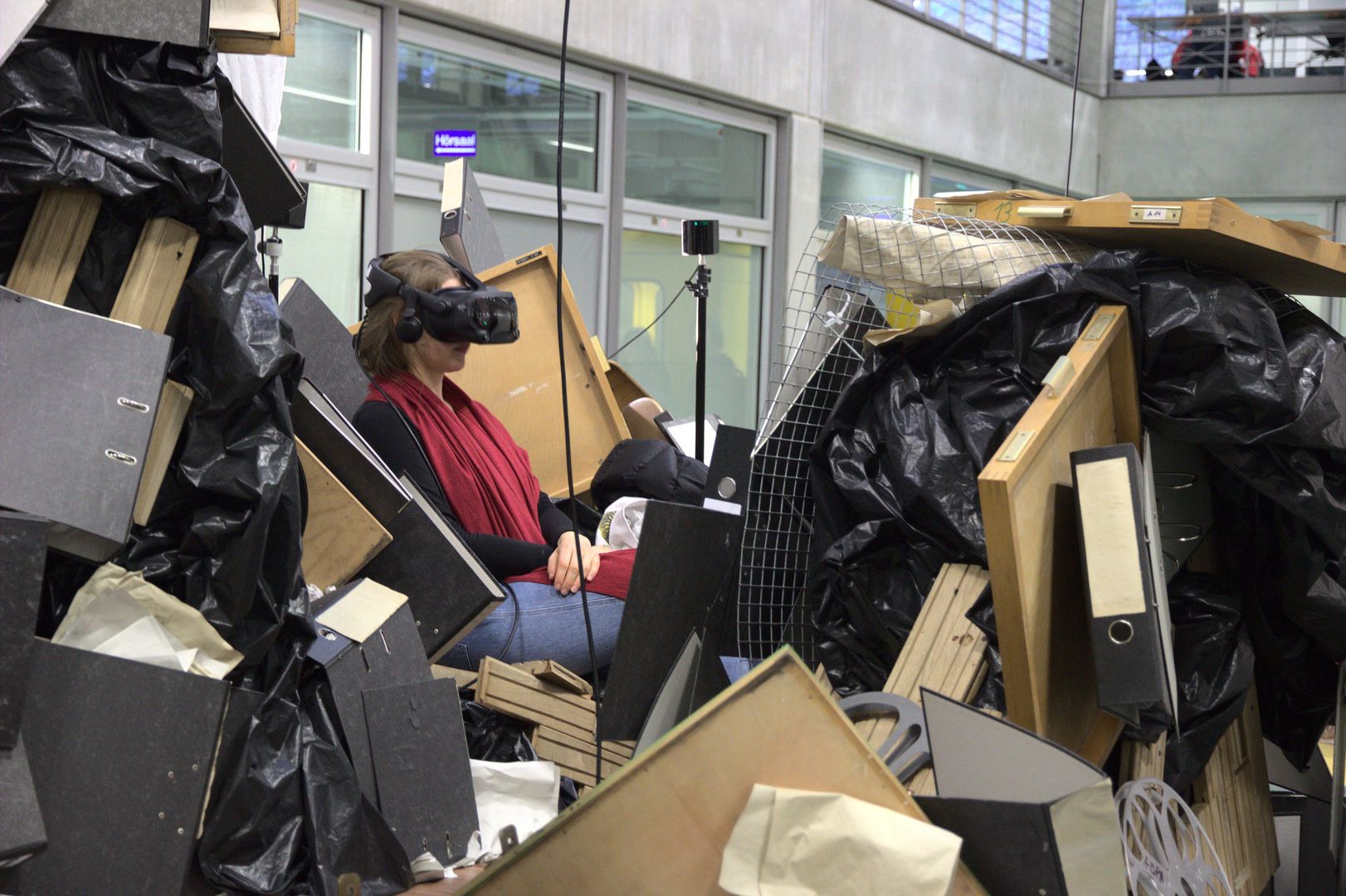
Höllerer VR is an interactive virtual reality installation developed for an exhibition commemorating the 100th anniversary of the German poet and literary scholar Walter Höllerer. The installation allowed visitors to explore fragments of Höllerer's literary environment through an immersive spatial narrative presented in VR.
Project Info
- Client: Studio Above & Below
- Location: TU Berlin University Library
- Category: VR Installation
- Role: Interaction Development
Context
Client Work / Exhibition Installation
The project was created as part of the exhibition “Die Umgebung der Wörter”, hosted at the TU Berlin University Library. The exhibition explored Walter Höllerer's influence on post-war German literature and intellectual culture.
The VR installation extended the physical exhibition into an immersive digital environment, allowing visitors to engage with the spatial and conceptual landscape surrounding Höller's work.
Process
My role focused on developing the interactive VR experience using Unity. I implemented the interaction systems, navigation logic, and spatial behaviors that allowed visitors to move through the environment and engage with narrative fragments embedded in the virtual space.
The challenge was to design interactions that were intuitive for first-time VR users while preserving the poetic atmosphere of the exhibition.
Architecture
- Unity
- C# Interaction Systems
- VR Interaction Design
- Exhibition Installation


Outcome
The installation was successfully deployed as part of the exhibition at TU Berlin University Library. Visitors were able to explore the virtual environment as an extension of the physical exhibition, creating a layered narrative experience combining literature, space, and digital interaction.
Reflection
This project reinforced the importance of designing VR interactions that remain accessible to non-technical audiences. In exhibition contexts, technology must disappear behind the experience so that visitors focus on the narrative rather than the interface.